Call new inquiries within the hour. The research is clear.
It's easy to believe your practice calls new inquiries back quickly. It's harder to know.
Ask most front desks how fast they return a web inquiry and you'll hear "same day" or "within a couple of hours." Ask them to show you, and the room gets quiet. Almost nobody times it, because nothing in the day forces them to.
What the research found
In 2011, researchers writing in Harvard Business Review audited 2,241 U.S. companies by sending each one a web inquiry and timing the reply. 37% responded within an hour. 24% took more than a day. 23% never responded at all.
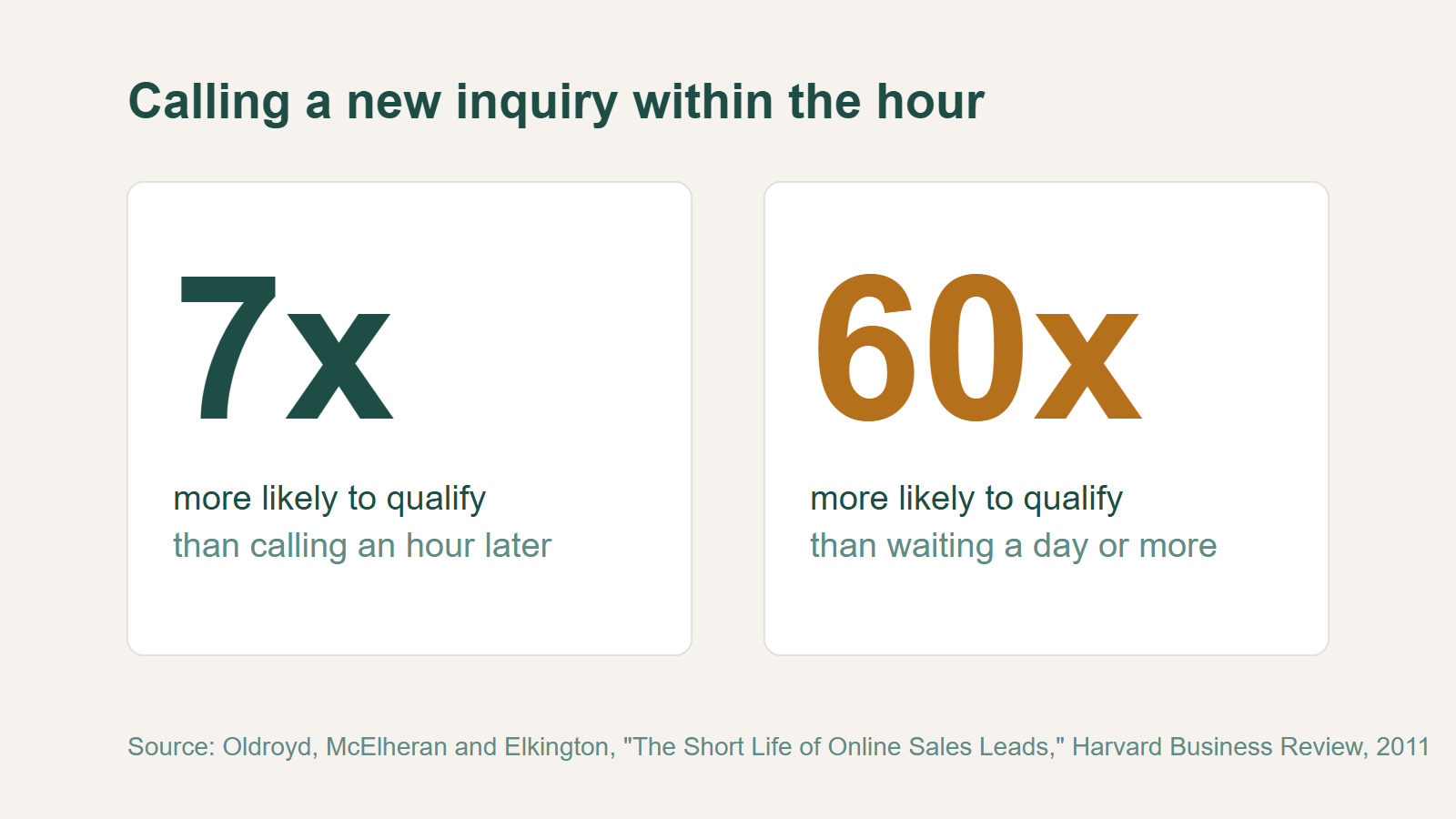
The same researchers looked at what speed was worth. Companies that tried to reach a new lead within an hour were nearly 7 times as likely to have a real conversation with that person as companies that waited even one more hour, and more than 60 times as likely as companies that waited a day or longer.
The study wasn't about plastic surgery, but the pattern will feel familiar to anyone who has worked a front desk. A patient who fills out a form at lunch is still thinking about it at lunch. By the next morning she may have read three other practices' websites and booked a consult with whoever called first.
Why speed slips in a busy practice
Speed usually slips for ordinary reasons, not because anyone is careless.
- The form goes to an inbox nobody watches on Fridays, or on the coordinator's day off.
- Calls get returned in the order someone remembers them, not the order they came in.
- A busy clinic day pushes callbacks to the end of the afternoon, and the afternoon fills up.
- Two people each assume the other one called.
- Inquiries from Instagram or Facebook live in a different place from phone messages, so they get checked less often.
None of these show up in a monthly marketing report. They only show up when someone looks at each inquiry and asks how long it waited.
How to measure your response time this week
You don't need new software to find out where you stand. Pick one week and do this:
- Write down every new inquiry as it arrives: the time it came in and where it came from.
- Write down the time of the first real attempt to reach that person, a call or a personal text, not an automatic email.
- At the end of the week, sort the list by how long each person waited.
Look at three numbers: how many were reached within an hour, how many waited past a day, and how many were never reached at all. Then look at when the slow ones came in. Most practices find the delays cluster around lunch, late afternoon, Fridays and anything that arrives after closing.
Setting a standard your team can hit
"Call everyone back immediately" isn't a standard. It's a wish. A standard is something your team can check against every morning.
A workable one looks like this: every inquiry that arrives during office hours gets a real attempt within an hour, and everything that arrived overnight gets called before 10 am. Anyone still waiting past six hours gets flagged, and anyone past eighteen hours is treated as urgent.
The point isn't to punish anyone for a slow day. It's to make the wait visible, so a busy afternoon doesn't quietly turn into a lost consult.
Make the wait visible
The simplest way to hold that standard is a list of every new inquiry nobody has handled yet, longest wait first, with anything past six hours flagged and anything past eighteen in red. It turns "we call back quickly" into something you can check every morning in a few seconds.
That's the first report PatientCadence sends: who is still waiting, before your first patient walks in. You don't have to log in or ask anyone to pull it.
If you only change one thing this month, start timing your callbacks. The number is usually a surprise.
Source: Oldroyd, McElheran and Elkington, "The Short Life of Online Sales Leads," Harvard Business Review, March 2011